
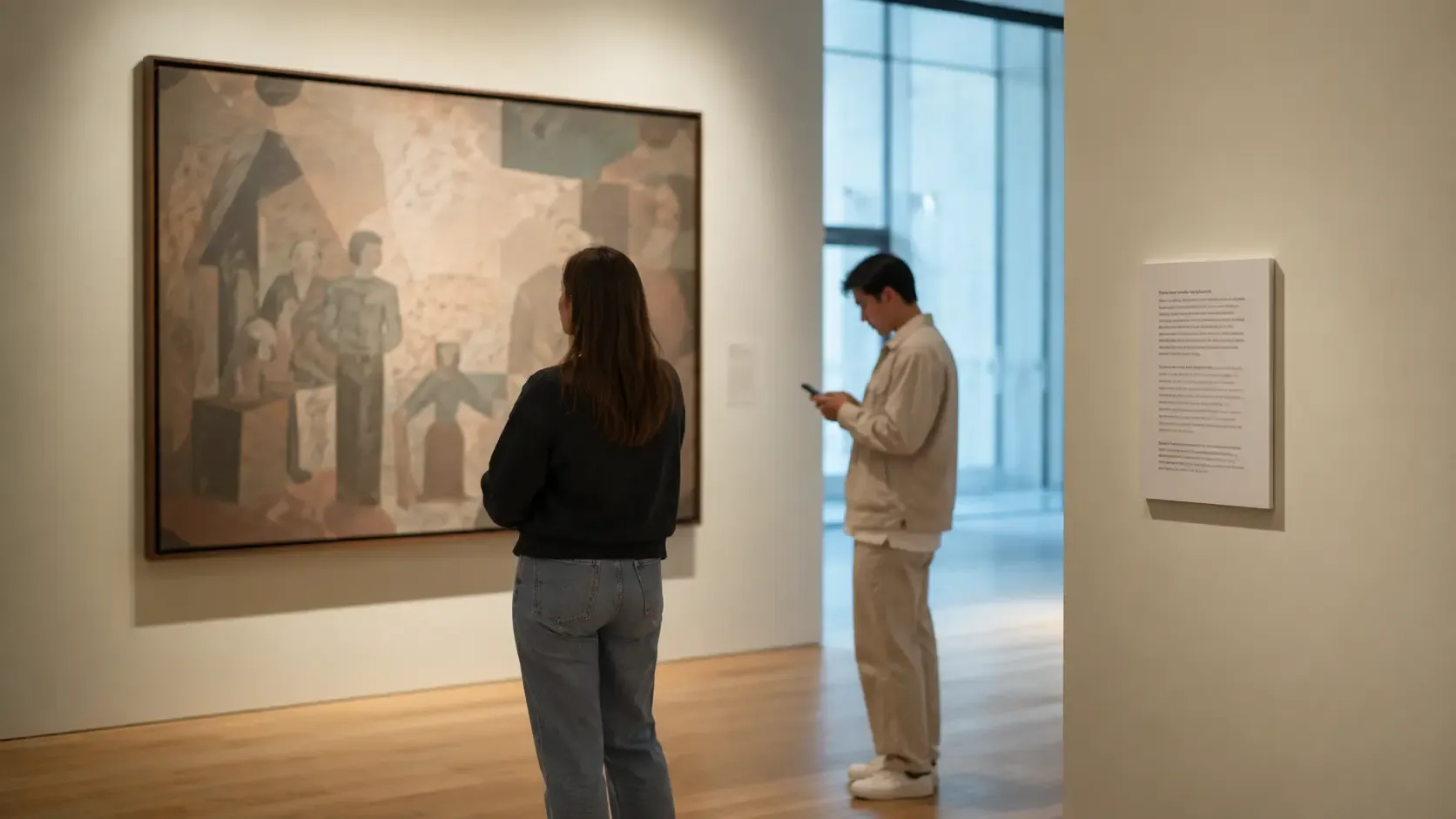
Museums remain some of the few places dedicated to slow contemplation. They are spaces where we can stop, observe, reflect and build connections between objects, stories and collective memory. Yet today, these same places need to communicate with visitors whose cognitive rhythms are very different from those of the past.
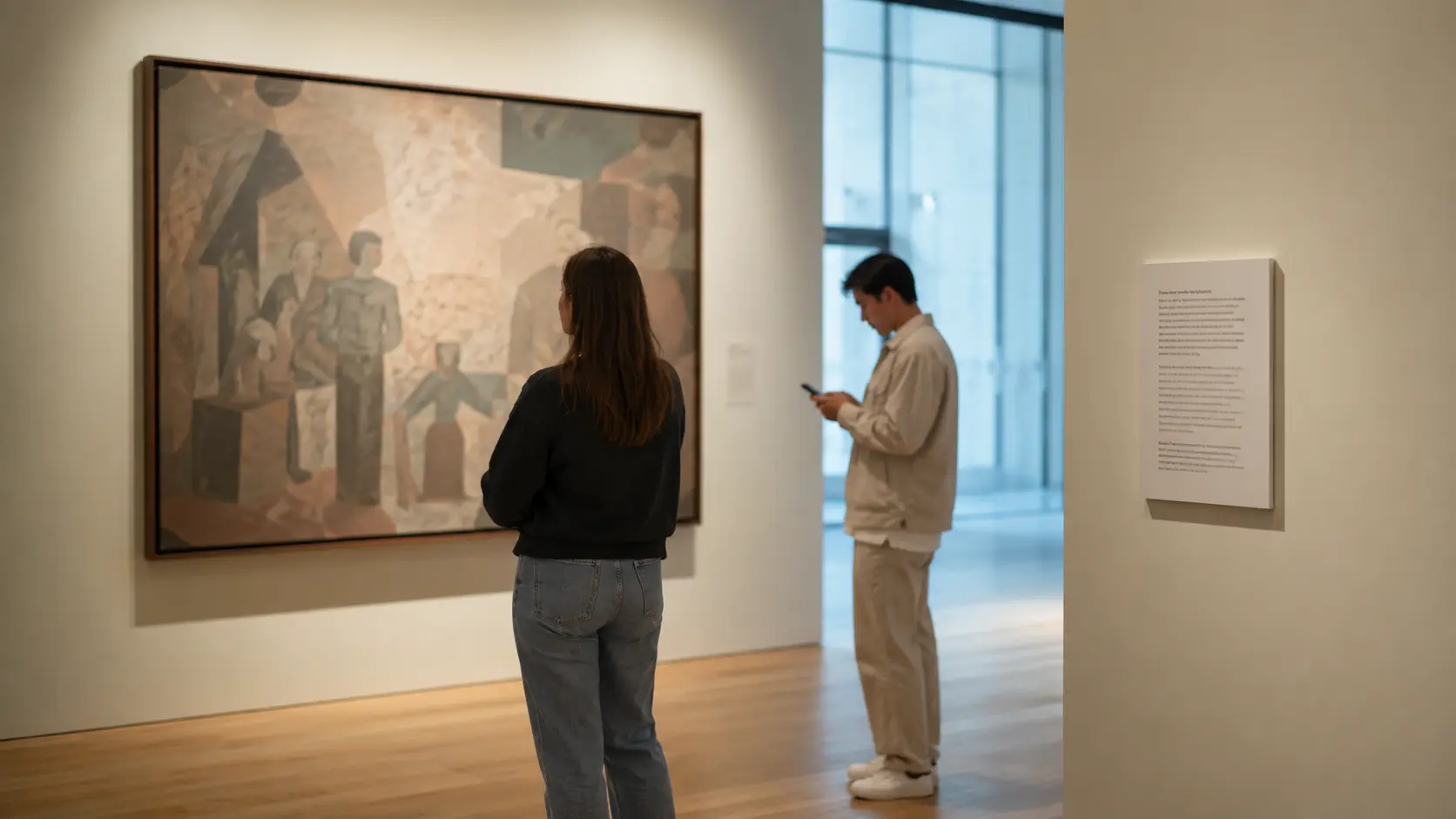
Anyone who works in museums or regularly visits exhibitions has probably seen the same scene many times: people stop in front of a panel for only a few seconds, read the first lines, or simply ignore it, before moving immediately to the next artwork. For a long time, this behaviour was interpreted as a lack of interest or attention. But the issue may be much more complex.
Attention has become a limited resource
We live in an age defined by an almost infinite amount of information. The internet allows us to access content, data, images and opinions from all over the world instantly. This has made information more democratic and accessible, but it has also created a new problem: the difficulty of choosing what truly deserves our attention.
Every day, we scroll through hundreds of pieces of content, move quickly from one stimulus to another and become used, almost unconsciously, to consuming information in a fast, fragmented and discontinuous way.
In his book The Shallows, Nicholas Carr reflects precisely on this transformation. According to Carr, digital technology is not only changing our habits, but also the way we think. He describes the transition from a “literary” mind, able to concentrate for long periods on complex texts and deep reflection, to a form of intelligence increasingly oriented towards speed, efficiency and multitasking.
The digital ecosystem constantly exposes us to notifications, interruptions and new stimuli, progressively reducing our ability to maintain prolonged and linear attention.
Today, we read differently
This does not necessarily mean a loss of interest in culture or complex content. On the contrary, we are witnessing a radical shift in the way information is processed. Today, we read differently. We quickly select what seems relevant, alternate between observation and movement, favour immediate content and often decide within seconds whether something deserves more attention.
Herbert Simon summarized this dynamic decades ago in a sentence that feels more current than ever: “A wealth of information creates a poverty of attention.” In a context dominated by overstimulation, attention has become a limited and fragile resource.
The impact on cultural spaces
This transformation is also visible in cultural spaces. The problem is not that visitors completely ignore textual content. On the contrary, they often read selectively: they look for the title of the artwork, a date or the first introductory sentence. Some photograph the panel to “read later”, while others prefer QR codes or digital supports because they feel more dynamic and interactive.
The contemporary visitor constantly alternates between observation, reading and movement, trying to orient themselves among a large amount of visual and informational stimuli.
The result, however, is often a fragmented experience. People move through rooms and collections without truly deepening what is in front of them. They observe important works without building lasting memory or deeper understanding. This is not necessarily due to a lack of curiosity, but because the cognitive context in which we live makes it increasingly difficult to maintain attention and concentration for long periods.
Museums themselves also require considerable cognitive effort. Visiting a cultural space involves observing, orienting oneself, making constant decisions, processing images, reading texts, interpreting information and building narrative connections. It is a cognitively intense experience. When panels are too long, too technical or too dense, the risk of overload quickly increases.
In many cases, visitors do not stop reading because they are uninterested, but because the experience already demands a great deal of attention. This is joined by a phenomenon known as museum fatigue: a progressive cognitive tiredness that leads visitors to reduce observation and reading time as the visit progresses.
The challenge is not to eliminate panels
This does not mean museums should remove panels or give up the complexity of their content. The current challenge is different: to rethink how information is presented, integrating tools and languages that are better suited to contemporary behaviours.
More and more cultural institutions understand the importance of building clearer information hierarchies, made up of shorter, modular and more readable texts, accompanied by different levels of depth. Storytelling plays a central role here: less purely technical description and more narrative, more emotional connection and a greater ability to create dialogue between the work and the visitor.
Multi-level content is also becoming essential. A concise panel can coexist with digital content, audio guides, QR codes and optional materials that allow visitors to choose autonomously how deeply they want to explore a topic. This approach makes the experience more flexible and personalized, respecting different levels of attention, interest and knowledge.
Cognitive accessibility as a principle
In this context, cognitive accessibility becomes essential. Using clear language does not mean making content superficial; it means making it genuinely accessible to a broad and diverse audience. Most people who enter a museum do not have specialized knowledge about the subject being presented. Readability, simplicity and clarity therefore become fundamental tools for promoting understanding, engagement and cultural participation.
The challenge for contemporary museums is not to renounce depth or complexity, but to find new ways of making them accessible, readable and engaging in a context where attention has become one of the most fragile resources of our time. Cultural spaces continue to play a fundamental role: offering places for reflection, contemplation and authentic connection with heritage.
But to do so, they need to learn how to communicate with a deeply transformed audience, one that now lives, reads and interprets the world very differently from only a few years ago.